Heidelberg Engineering Announces 85,000 Hz OCT2
Next Generation SPECTRALIS OCT Module

Hemel Hempstead, UK – New Module Exhibited at American Society of Cataract and Refractive Surgery, Booth #2139

Heidelberg, Germany – Heidelberg Engineering announces significant improvements to the SPECTRALIS® OCT2 Module.

The OCT2 Module brings the next generation OCT technology to the SPECTRALIS diagnostic imaging platform. It combines a high scan rate with Heidelberg Engineering’s proprietary TruTrack Active Eye Tracking, to provide unmatched image quality and significantly improved acquisition speed. New applications such as OCT Angiography* will build on the OCT2 Module.

Since its debut at the 2014 American Academy of Ophthalmology in Chicago, the OCT2 Module is an option for all new SPECTRALIS models. In addition, a large number of SPECTRALIS devices in use, depending on their technical specifications, can be upgraded with the OCT2 Module.

Introduced with an already high scan rate of 70,000 Hz, Heidelberg Engineering was able to achieve another significant improvement in the acquisition speed.

Dr. Kester Nahen, Managing Director at Heidelberg Engineering states, “Over the last months, our team in Heidelberg was able to increase the scan rate of the OCT2 Module from 70,000 Hz to 85,000 Hz. This is an important achievement and further substantiates the sound technology pathway we have defined. I’m confident that our customers will be delighted with this even more powerful engine.”

Dr. Jörg Pintaske, Head of Marketing at Heidelberg Engineering adds, “In today’s rapid pace of technological evolution, the company’s commitment to sustainability and value proposition is something that is not often seen in the medical device business. In our opinion, this represents a significant value to customers and the concept of expandability is a major reason why eye care professionals all around the world consider our products an excellent choice, not only from a clinical but also from an economical perspective.”
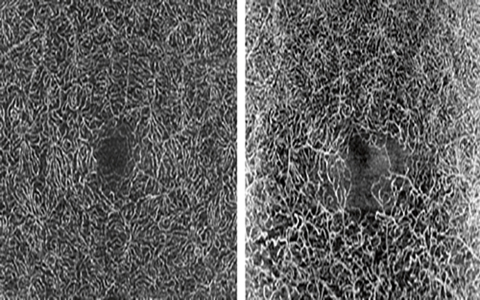
Left: OCT Angiography of the deep vascular network in a healthy eye. Right: OCT Angiography of an old BRVO with visible changes in the deep vascular network, clearly seen between inferior and superior. OCT Angiography will build on the OCT2 Module.
Left: OCT Angiography of the deep vascular network in a healthy eye.
Right: OCT Angiography of an old BRVO with visible changes in the deep vascular network, clearly seen between inferior and superior. OCT Angiography will build on the OCT2 Module.


*OCT Angiography is under development and not for sale yet.

Heidelberg Engineering launches Connect Investment Club

Hemel Hempstead, UK – The new SPECTRALIS Connect Investment Club, was launched by Heidelberg Engineering at Optrafair, is set to bring cost savings and to facilitate access to the most advanced eye scanning technology.

All purchasers of SPECTRALIS OCT and Heidelberg Engineering’s upgradeable platform are eligible to join the club, which brings great benefits, as Krysten Williams, Heidelberg Engineering Director, explained –

“The more practices that join us in using the SPECTRALIS platform, the greater the savings will be for all. The scheme covers all methods of financing the purchase. Optrafair is the time when we want to really promote the fact that we have not just a superb OCT, but also an expandable multi-modality platform for enhanced patient care: an investment for the future,” said Krysten.

(more…)

Heidelberg Engineering´s OCT Case Clinic is major event at Optrafair

Hemel Hempstead, UK –Understanding the role OCT plays in the early diagnosis of disease, and improved patient care, is the focus of Heidelberg Engineering’s educational programme at Optrafair: 18-20 April.

The Birmingham show’s new OCT Case Clinic peer discussions, sponsored by Heidelberg Engineering, will examine real cases submitted by practices around the UK. Expert review, and discussion, of submissions offer the opportunity to gain practical knowledge and build confidence from the six free to attend 90 minute sessions.

“OCT isn’t everything,” explained Christopher Mody, Heidelberg Engineering Clinical Programme Manager – “The OCT Case Clinic is designed to help clinicians understand the part OCT plays in relation to other diagnostic information, as well as the significance of visualising structural changes to narrow the differential diagnoses and make confident decisions.”

“Regardless of which OCT you use, it should not be used independently, and it cannot replace your clinical judgement. The OCT Case Clinic is designed to put OCT into context as a valuable diagnostic tool that can enhance patient care when used as part of a multi-modality approach to diagnosis and monitoring of disease.”

In addition to the OCT Case Clinics, Heidelberg Engineering will sponsor two hours of CET lectures, centred on promoting and profiting from clinical services and improving patient care. The launch of the Connect Business Academy at Optrafair provides users with expert advice and guidance in aspects such as data mining, designing the patient journey, shared care, social media, patient education and staff training.

With an emphasis on both clinical and business education, Heidelberg Engineering’s presence at the Birmingham show highlights the benefits of implementing a multi-modality imaging approach for early disease detection, accurate diagnosis and monitoring change.

All OCT case studies are invited for discussion to: Academy-UK@heidelbergengineering.com

NASA presents Heidelberg Engineering the
NASA Certificate of Appreciation

Carlsbad, CA, USA — Heidelberg Engineering was honoured today by visitors from NASA. The guests from NASA: Dr. Christian Otto, Lead Scientist for the Vision Impairment and Intracranial Pressure (VIIP) project; Dr. Steven Hart, lead flight surgeon for VIIP; Rachel Brady, VIIP Science Coordinator; and Jennifer Villarreal, Project Manager came for a ceremony to present Heidelberg Engineering with the NASA Certificate of Appreciation in recognition of Heidelberg Engineering’s support in placing a SPECTRALIS® OCT system on the International Space Station (ISS).

During the ceremony, the NASA guests described the physiological challenges encountered with long duration space flight and the research underway to understand and ultimately address these issues. A big part of this research is evaluating changes in ocular structures with the Heidelberg Engineering SPECTRALIS system.

The SPECTRALIS, installed on the ISS in June, 2013, is the same SPECTRALIS technology available to eye care practitioners for terrestrial use. Since initiation of this program, ISS astronauts have been receiving baseline SPECTRALIS exams before flight and routine SPECTRALIS exams throughout their space station deployments.

Originally, NASA anticipated the process of qualifying and placing the SPECTRALIS in space would take approximately two years. Instead, due to the efforts of the Heidelberg Engineering team, the system was delivered to the ISS within four months. In recognition of this effort, Heidelberg Engineering was presented with two plaques signed by Dr. Jeffrey Davis, Chief Medical Officer of NASA’s Johnson Space Center, and astronaut Luca Parmitano, who was among the first crew members to operate the SPECTRALIS OCT during flight.

Heidelberg is ready for 100% Optical delegates

Hemel Hempstead, UK – New advances in OCT and fundus imaging are available for hands-on trialling at the Heidelberg Engineering stand with the SPECTRALIS technology.

A new module makes simultaneous widefield OCT (up to 16.5mm) and 55 degree fundus imaging possible with the SPECTRALIS platform. Continuously updating, thanks to the modular design of the system, this technology brings peace of mind in knowing that the SPECTRALIS can be upgraded with the latest developments.

Supported by the Connect Business Academy and access to educational events – pitched at all levels within the practice – the support offered to users is unrivalled, believes Heidelberg Engineering. Customers who make the most of the expert advice, clinical training, technical support and comprehensive marketing programmes can maximise their investment in OCT from the outset, believes the company.

“We know that our SPECTRALIS users come from a broad spectrum of OCT imaging experience – some are newcomers to the technology while others are moving to the SPECTRALIS multi-modality imaging platform from an OCT instrument. Whatever the level of understanding, we have support and education to help users to engage patients, employees, and local GPs, CCGs, consultants and hospitals. We see this as the way forward,” said Tosh Vadhia, National Sales Manager.

Highlighting the world class connections that Heidelberg Engineering engenders, guest speaker at 100% Optical will be Professor Sanjay Asrani from Duke University, Durham (NC). The CET accredited lecture that he will deliver at the show will reflect his position as a leading international glaucoma specialist and American Academy of Ophthalmology Award winner.

In addition, Heidelberg Engineering will lead case study discussions on OCT in Acute Visual Loss, covering retinal diseases most commonly seen in practice, with signs, symptoms and referral protocol.

Promoting the benefits of MultiColor imaging, Heidelberg Engineering will highlight –

  • The principles of OCT testing in glaucoma
  • Macular thickness in conjunction with nerve fibre layer assessment in glaucoma
  • Artifacts and pitfalls of OCT

Practitioner Praise

New to the SPECTRALIS – and indeed, OCT – technology is Yorkshire independent optometrist and practice owner, Mark Holloway. His Dronfield, Sheffield, practice places a great emphasis on quality of service and clinical excellence –

“We did a lot of research on OCT and opted for the SPECTRALIS because it is easy to use, easy to position patients, and because the quality of the images is very good. We really like the active eye-tracking and confidently knowing that we are detecting change in the correct place and not seeing change because we might be scanning two millimetres to the left or right of the original scan.”

Support for Hospital Services is way forward

Hemel Hempstead, UK – Opticians can flourish by becoming primary care providers – by managing and monitoring hospital patients in a community setting – believe Heidelberg Engineering’s UK business leaders.

“You only have to look at the number of pop-up clinics around the country – in a wide range of specialties – to see that some healthcare trusts are challenged with the workload. Time is of the essence for AMD and glaucoma patients. We are urging optometrists to make contact with their local ophthalmology departments to find out what they can provide in terms of community services, to reduce the strain on over-burdened clinics,” said Kenny Boyle, Heidelberg Engineering UK Key Accounts Manager.

He warned that “hospitals will struggle to cope with demand – especially if Dry AMD pharmacology is approved. If patients do not meet the requirements for clinical treatment, they may get bounced back – High Street opticians need to have a superior diagnostic ability to review patient data and images – perhaps sometimes remotely,” he added.

The soon to be released upgrade for the SPECTRALIS OCT platform, HEYEX PACS* (Heidelberg Eye Explorer) is an image management and device integration software system which facilitates this shared care approach. This one central application – for Heidelberg Engineering’s and other companies’ ophthalmologic images – provides the facility to access data and images and to review and compare scans.

“Our new software launch follows the acquisition by Heidelberg Engineering last year of a specialist technology company which has provided data management services – mainly in the field of radiology – for 20 years,” said Tosh Vadhia, National Sales Manager.

“Secure, reliable and fast, it is a scalable system designed to meet the individual needs of independent and multicentre clinics – matching the Heidelberg Engineering ethos of providing a flexible, expandable business platform,” he said.

*HEYEX PACS is currently under development and not yet available for sale.